Fringes is learning. As darkness approached I saw that instead of the ground it had chosen a broad ledge on the side of the building on which to spend the night. Safety! :-)
Monday, 15 October 2012
Sunday, 14 October 2012
FRINGES FEEDS
Fringes again spent the night on the ground in its favourite spot--safely, to my relief. In the morning fourteen adult doves came down to feed when I emerged. I assume that the lower numbers means that there are several sitting on nests. And some adults are eating fit to bust but are staying slender, so they must be feeding chicks somewhere.
At first this morning there was the normal melee when they are all scrambling over each other to eat bits of Colby cheese from my hands, followed by bits of bread. Then I scatter rolled oats about. When they were eating the latter Fringes came and joined them and ate too, making the plaintive 'Feed me!' cries to the ground instead of a parent. Earth Mother?
It had tried a little bit of other food on the ground yesterday, rather hesitantly, but today was the first time it had joined the rest and fed with them (I have yet to work out if it is male or female). Quick learner...
I hope it will not be long before it learns that doves go high up into the trees for the night. A parent has been lingering with it until almost dark but it has yet to get the message and follow.
Till it does, stay away cats and dogs!

Thursday, 11 October 2012
FRINGES BENEFITS
'Fringes,' the first of the spring chicks, did survive its all-night stay on the ground, and after making plaintive pleas to adult after adult after adult I saw it find at least one parent, and be fed. :-)
Wednesday, 10 October 2012
FIRST CHICK OF SPRING
I went out at twilight, and found three doves on the ground. Two obviously knew me, but the third, a smaller bird, did not know what to make of this large creature. I soon realised from its ceres, the stains of pigeon milk down its breast, and its plaintive cries that it was the first chick I have seen this spring.
I managed to get a photo of it, although it was just after six so the light was too dim for a good shot, but I did not want to use a flash for fear of frightening it. Adult birds do not mind a flash but it has never seen one.
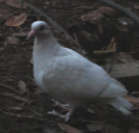 It obviously did not know what to do, or how to get back to its nest. It must have followed another bird down, but not back, so it had to settle down in a hollow between roots where it will have to spend the night. I'm glad the black cat that had been trying to get at the doves vanished months ago. I hope it survives.
The new bird has distinctive feathering on its legs and feet--rather like the fringes some cowboys had on their leather pants, so I shall call it Fringes.
I managed to get a photo of it, although it was just after six so the light was too dim for a good shot, but I did not want to use a flash for fear of frightening it. Adult birds do not mind a flash but it has never seen one.
It obviously did not know what to do, or how to get back to its nest. It must have followed another bird down, but not back, so it had to settle down in a hollow between roots where it will have to spend the night. I'm glad the black cat that had been trying to get at the doves vanished months ago. I hope it survives.The new bird has distinctive feathering on its legs and feet--rather like the fringes some cowboys had on their leather pants, so I shall call it Fringes.
Tuesday, 28 August 2012
DOVES: ILLNESS, RECOVERY, AND DEATH
In late July I noticed that the dove I call Placida, because she has an unusually placid nature, even for a dove, was standing apart from the rest, not looking happy. Later, when I found her on the doorstep shivering I let her inside. Her behaviour, and her pale beak, showed plainly that she was not well, and she ended up staying inside for two nights and nearly two days, while I looked after her, hand-feeding her with food and water. After that she left of her own accord and was back to her old self.
A week or two into August I noticed that another did not look happy. This one had a decided limp, and her head-feathers had been stained a ginger colour--I assume by rainwater dripping through epiphytes above where she roosts at night--so I dubbed her Limping Ginger. She had no mate, which is why her head-feathers were never cleaned; only the birds with mates to groom their heads can keep them white.
I thought at first that the reason she was favouring her left leg was because she had injured it somehow, perhaps by coming in for a heavy landing one day. But she did not lose her limp, and because that was affecting her balance she took to nestling for the night on the doorsill--obviously because if she had roosted on tree-branch for the night and had lost her balance she would have fallen uncontrollably into the dark unknown.
But she carried on eating, even being in the thick of the breakfast melees in the mornings, so I thought she would get over her limp and get back to normal. Her variable balance did prevent her from grooming herself properly because she would soon fall on her beak or her side, so she became very unkempt, especially at the end of her tail.
Two days ago she came inside, and pecked about, but as evening came she was obviously not interested in going back into the cold air for the night, so she stayed inside. She went off her food yesterday, but she took water from time to time, and I expected that what happened to her would a repeat of what had happened to Placida. She would stay inside till she recovered.
Last night her eye was bright, and she seemed alert, and as late as ten o'clock she was pecking up bits that I had put down on the floor for her. But at eleven I noticed that her breathing had become quicker and shallower, which was worrying.
I woke not long after four this morning and rose to check on her, and to my dismay found that she had died. At the very first of first light I took her out and buried her in the forest at the foot of the large boulder where I had buried the other doves that had died.
There is something especially poignant about the death of a dove.

Thursday, 19 July 2012
WAIHEKE AND ROCKY BAY DO NOT EXIST!
In 1642 Abel Tasman was the first to put pen to paper and make a map of any part of New Zealand. In 1769 James Cook was the first to make a complete map of the country, albeit from sea. New Zealand dates its founding as a nation from the signing of the Treaty of Waitangi between the British Crown and the native Maoris in 1840.
But 370 years after Tasman, 243 years after Cook, and 172 years after the Treaty, New Zealand still does not have a complete official map. With GPS we can found out where we are in any place in the country to within centimetres, but there are tens of thousands places whose names we do not know, at least officially. Officially they do not exist.
For a placename to be official in New Zealand it must have been approved and gazetted by the New Zealand Geographic Board. But the Board has done that for only 7500 names. Important ones, such as Wellington (New Zealand's capital city), Auckland (its biggest city), North Island, South Island, etc., etc.,--tens of thousands of names have yet to be placed officially on the map.
(Actually 'North Island' has been gazetted, but not for the North Island of the country, the northernmost of its three main islands where most of the population lives; only for some obscure little dot in the Mutton Bird islands in Fouveaux Strait way down near the southernmost tip of New Zealand!!! So to be strictly legal you cannot say that Auckland and Wellington and many other places are in the North Island, because they are not on that tiny Mutton Bird island--nor could they be: they cannot fit.)
Everyone, surely, has the right to live in a place that has an official name. Otherwise you cannot have an address, an identifiable property, no one can find you, emergency services may not be able to serve you, your mail may never come or go astray, etc.
There are three categories of names in New Zealand: official (gazetted), unofficial ('recorded'), and neither. 'Recorded' only means that the Geographic Board is of the opinion that a name has been mentioned at least twice on what it regards as an authorative map or database, but it has yet to be officially approved and recognised. It does not officially exist in law.
'Waiheke Island' is only recorded, and therefore has no official legal status. 'Rocky Bay', despite the fact that it has appeared on many maps and databases since at least 1877 has not even been recorded.
That is why at last night's meeting of the Waiheke Local Board I sought its support for putting Rocky Bay on the map. What follows is the written submission made to the board, which was supported by copies of old maps held in the Auckland War Museum Library that are too big to be shown here.
REQUEST TO THE WAIHEKE LOCAL BOARD
TO SUPPORT AN APPLICATION TO THE NEW ZEALAND GEOGRAPHIC BOARD
TO APPROVE AND GAZETTE FOUR WAIHEKE PLACENAMES
* Omiha/Rocky Bay as the dual name of that village.
* Omiha Bay/Rocky Bay as the dual name of that bay.
* Whakanewha Bay as the name of the bay on the edge of Whakanewha Regional Park
* Omiha Point as the name of the unnamed point at the northern end of Rocky Bay
Wendy Shaw, the Secretary of the New Zealand Geographic Board, told me in early July this year that only 16,000 placenames in New Zealand have been approved and gazetted by the Board, a further 35,000 have been recorded (acknowledged but not approved and gazetted), which leaves an unknown number in neither category. But in fact the Geographic Board's website lists only 7500 that have been approved and gazetted. 'Wellington' and 'Auckland' are just two of myriads that have yet to be approved and gazetted--but the North Shore suburb of Chatswood has been! It is very disappointing to find that in 2012 this country has such a mess of a map.
Included in the myriads in that third-level Black Hole is Rocky Bay as the name of the bay and the village, and Whakanewha Bay.
The system operated by the New Zealand Geographic Board is cumbersome. The application form is not well designed, a separate application must be made for every name (even when approval is being sought for a clutch of names in common use, and even if those have been recorded), and the Board meets only a few times a year, and may defer decisions indefinitely. So the process can be long and tedious.
The Waiheke Community Board has received an odd letter from the Geographic Board about a straightforward application that was made a year ago. The wording is odd, and the determination is quite wrong because the Board's advisors misread the application, which was for what heads these notes--for dual names. But they misread it as an application to replace Omiha Bay with Rocky Bay.
Many problems can of course be caused by wrong names on maps, and when names have not been gazetted, or even recorded, there is no authoritative source to correct errors. Therefore names in common daily use, even ones with a long and authoritative provenance, may be rejected by officialdom, which can cause day-to-day problems and may make emergencies more dangerous.
The worst day-to-day problems I have personally experienced were caused by the fact that New Zealand Post refuses to recognise placenames that have not been gazetted or recorded.
In Rocky Bay only 'Omiha' has any kind of recognition, because it has been recorded, although not gazetted. None of the names sought here have been gazetted.
Starting in 2008 I had contact with a David Wilson, who glories in the title of Senior Addressing Support Analyst at New Zealand Post and sets the rules for addressing mail. He refuses to allow Rocky Bay, because it is neither recorded nor gazetted, and he enforces his rule with they threat of disqualification for the bulk-mailing discount. His reach is long and wide, and includes overseas entities such as National Geographic and Dell. So if people who live in Rocky Bay fill in their address as 'Rocky Bay' they are very likely to find it changed to Omiha. That caused me a nasty problem when Dell sent some expensive hardware that never arrived. Dell clearly thought that I had received them, and was lying to get them without fulfilling my side of the bargain. I finally tracked them down gathering dust in a bin somewhere in Christchurch, which also has an Omiha. On that occasion I knew that mail had gone astray. Very often we would not. How much has, and for how many people, is impossible to tell.
At one stage I was even disenfranchised--removed from the electoral roll--because of the compulsion organisations are put under by the Post Office, and the electoral computer would not accept my address.
But regardless of such problems it is clearly most unsatisfactory to have a situation where well-established placenames are not recognised, not approved, not gazetted, and therefore rejected by various officials. So I ask the Waiheke Local Board to support this application to the New Zealand Geographic Board.
As you can see from the historical maps supplied to me by Paul Monin who got them from the Auckland War Memorial Museum Library, 'Rocky Bay' for the bay, 'Omiha' for the village area, and 'Whakanewha Bay' for the big bay along the edge of Whakanewha Regional Park, all have provenance going back at least as far as 1877.
The Honourable Sandra Lee says 'Omiha' was a Maori princess from another tribe who was captured by the tribe that lived in Rocky Bay and subsequently married a man from it, which reconciled the two tribes. We should obviously honour that positive heritage.
In law New Zealand has three official languages, including English and Maori of course, and therefore with that dual historical provenance it is fitting to have dual English and Maori names. For the bay itself, Rocky Bay has provenance going back to at least 1877, and Omiha Bay has been recorded in recent times. It would therefore be proper to gazette both of them. Then Post Office bureaucrats would have to accept Rocky Bay, and there could be no valid confusion in the emergency services. Whakanewha Bay also has provenance back to at least 1877. And naming the unnamed point at the northern end of Omiha Bay/Rocky Bay as Omiha Point would further honour the much older Maori provenance (Sandra says it goes back centuries).
Then Rocky Bay would be officially gazetted twice: as the English name of the village and the English name of the bay. And Omiha would officially be in the area four times: gazetted as the Maori name of the village and the bay and the name of its northern point, as well as in Omiha Road.
Obviously there are many placenames on the island that must be officialised until every single one has been put firmly on the map, but this four-fold application for Rocky Bay is as good a place as any to start, and a start on it has already been made, and therefore it needs only the Local Board's approval to continue to its proper, gazetted conclusion.
Then Rocky Bay and Whakanewha Bay will be up there with Chatswood and Rat Island...
.......
Update: That was the grand plan. But the Waiheke Local Board proved itself incapable of making such a simple, obvious decision, pulled the old trick of asking for 'officials' to make a report, got the do-nothing report it wanted, and decided to do that. Nothing. So we remain down there, with the nameless rats: the bureauc-rats.
But 370 years after Tasman, 243 years after Cook, and 172 years after the Treaty, New Zealand still does not have a complete official map. With GPS we can found out where we are in any place in the country to within centimetres, but there are tens of thousands places whose names we do not know, at least officially. Officially they do not exist.
For a placename to be official in New Zealand it must have been approved and gazetted by the New Zealand Geographic Board. But the Board has done that for only 7500 names. Important ones, such as Wellington (New Zealand's capital city), Auckland (its biggest city), North Island, South Island, etc., etc.,--tens of thousands of names have yet to be placed officially on the map.
(Actually 'North Island' has been gazetted, but not for the North Island of the country, the northernmost of its three main islands where most of the population lives; only for some obscure little dot in the Mutton Bird islands in Fouveaux Strait way down near the southernmost tip of New Zealand!!! So to be strictly legal you cannot say that Auckland and Wellington and many other places are in the North Island, because they are not on that tiny Mutton Bird island--nor could they be: they cannot fit.)
Everyone, surely, has the right to live in a place that has an official name. Otherwise you cannot have an address, an identifiable property, no one can find you, emergency services may not be able to serve you, your mail may never come or go astray, etc.
There are three categories of names in New Zealand: official (gazetted), unofficial ('recorded'), and neither. 'Recorded' only means that the Geographic Board is of the opinion that a name has been mentioned at least twice on what it regards as an authorative map or database, but it has yet to be officially approved and recognised. It does not officially exist in law.
'Waiheke Island' is only recorded, and therefore has no official legal status. 'Rocky Bay', despite the fact that it has appeared on many maps and databases since at least 1877 has not even been recorded.
That is why at last night's meeting of the Waiheke Local Board I sought its support for putting Rocky Bay on the map. What follows is the written submission made to the board, which was supported by copies of old maps held in the Auckland War Museum Library that are too big to be shown here.
REQUEST TO THE WAIHEKE LOCAL BOARD
TO SUPPORT AN APPLICATION TO THE NEW ZEALAND GEOGRAPHIC BOARD
TO APPROVE AND GAZETTE FOUR WAIHEKE PLACENAMES
* Omiha/Rocky Bay as the dual name of that village.
* Omiha Bay/Rocky Bay as the dual name of that bay.
* Whakanewha Bay as the name of the bay on the edge of Whakanewha Regional Park
* Omiha Point as the name of the unnamed point at the northern end of Rocky Bay
Wendy Shaw, the Secretary of the New Zealand Geographic Board, told me in early July this year that only 16,000 placenames in New Zealand have been approved and gazetted by the Board, a further 35,000 have been recorded (acknowledged but not approved and gazetted), which leaves an unknown number in neither category. But in fact the Geographic Board's website lists only 7500 that have been approved and gazetted. 'Wellington' and 'Auckland' are just two of myriads that have yet to be approved and gazetted--but the North Shore suburb of Chatswood has been! It is very disappointing to find that in 2012 this country has such a mess of a map.
Included in the myriads in that third-level Black Hole is Rocky Bay as the name of the bay and the village, and Whakanewha Bay.
The system operated by the New Zealand Geographic Board is cumbersome. The application form is not well designed, a separate application must be made for every name (even when approval is being sought for a clutch of names in common use, and even if those have been recorded), and the Board meets only a few times a year, and may defer decisions indefinitely. So the process can be long and tedious.
The Waiheke Community Board has received an odd letter from the Geographic Board about a straightforward application that was made a year ago. The wording is odd, and the determination is quite wrong because the Board's advisors misread the application, which was for what heads these notes--for dual names. But they misread it as an application to replace Omiha Bay with Rocky Bay.
Many problems can of course be caused by wrong names on maps, and when names have not been gazetted, or even recorded, there is no authoritative source to correct errors. Therefore names in common daily use, even ones with a long and authoritative provenance, may be rejected by officialdom, which can cause day-to-day problems and may make emergencies more dangerous.
The worst day-to-day problems I have personally experienced were caused by the fact that New Zealand Post refuses to recognise placenames that have not been gazetted or recorded.
In Rocky Bay only 'Omiha' has any kind of recognition, because it has been recorded, although not gazetted. None of the names sought here have been gazetted.
Starting in 2008 I had contact with a David Wilson, who glories in the title of Senior Addressing Support Analyst at New Zealand Post and sets the rules for addressing mail. He refuses to allow Rocky Bay, because it is neither recorded nor gazetted, and he enforces his rule with they threat of disqualification for the bulk-mailing discount. His reach is long and wide, and includes overseas entities such as National Geographic and Dell. So if people who live in Rocky Bay fill in their address as 'Rocky Bay' they are very likely to find it changed to Omiha. That caused me a nasty problem when Dell sent some expensive hardware that never arrived. Dell clearly thought that I had received them, and was lying to get them without fulfilling my side of the bargain. I finally tracked them down gathering dust in a bin somewhere in Christchurch, which also has an Omiha. On that occasion I knew that mail had gone astray. Very often we would not. How much has, and for how many people, is impossible to tell.
At one stage I was even disenfranchised--removed from the electoral roll--because of the compulsion organisations are put under by the Post Office, and the electoral computer would not accept my address.
But regardless of such problems it is clearly most unsatisfactory to have a situation where well-established placenames are not recognised, not approved, not gazetted, and therefore rejected by various officials. So I ask the Waiheke Local Board to support this application to the New Zealand Geographic Board.
As you can see from the historical maps supplied to me by Paul Monin who got them from the Auckland War Memorial Museum Library, 'Rocky Bay' for the bay, 'Omiha' for the village area, and 'Whakanewha Bay' for the big bay along the edge of Whakanewha Regional Park, all have provenance going back at least as far as 1877.
The Honourable Sandra Lee says 'Omiha' was a Maori princess from another tribe who was captured by the tribe that lived in Rocky Bay and subsequently married a man from it, which reconciled the two tribes. We should obviously honour that positive heritage.
In law New Zealand has three official languages, including English and Maori of course, and therefore with that dual historical provenance it is fitting to have dual English and Maori names. For the bay itself, Rocky Bay has provenance going back to at least 1877, and Omiha Bay has been recorded in recent times. It would therefore be proper to gazette both of them. Then Post Office bureaucrats would have to accept Rocky Bay, and there could be no valid confusion in the emergency services. Whakanewha Bay also has provenance back to at least 1877. And naming the unnamed point at the northern end of Omiha Bay/Rocky Bay as Omiha Point would further honour the much older Maori provenance (Sandra says it goes back centuries).
Then Rocky Bay would be officially gazetted twice: as the English name of the village and the English name of the bay. And Omiha would officially be in the area four times: gazetted as the Maori name of the village and the bay and the name of its northern point, as well as in Omiha Road.
Obviously there are many placenames on the island that must be officialised until every single one has been put firmly on the map, but this four-fold application for Rocky Bay is as good a place as any to start, and a start on it has already been made, and therefore it needs only the Local Board's approval to continue to its proper, gazetted conclusion.
Then Rocky Bay and Whakanewha Bay will be up there with Chatswood and Rat Island...
.......
Update: That was the grand plan. But the Waiheke Local Board proved itself incapable of making such a simple, obvious decision, pulled the old trick of asking for 'officials' to make a report, got the do-nothing report it wanted, and decided to do that. Nothing. So we remain down there, with the nameless rats: the bureauc-rats.
Wednesday, 18 July 2012
A DOVE CHICK IN WINTER!
When I went out into the forest this morning I was as usual soon surrounded by many doves wanting to be fed, but to my surprise from somewhere in the midst of the flight I could hear the plaintive sounds of a chick. In winter!? But after a time I managed to look at it closely enough for long enough to see that its ceres were pink, so it is definitely a chick (ceres are the bulges at the top of the beak, and in doves they are pink in chicks then turn whitish when when the birds mature)
A chick in July! How did its parents keep the egg then the new-hatched unfledged youngster warm enough for it to survive!?
Later when I went into my office the adult female that I have named Placida because she has such placid nature came in too, and after pecking about for a while flew up to the fax-machine for a snooze as is her habit.
After about twenty minutes she started looking about, which usually means she wants to go outside, so I opened the outside door for her. She ignored it, but another dove took the opportunity to come in. When I closed the door that one took off and flew round my office, beautifully fluttering with tail spread, but not like any other dove had ever done when inside. This one was flying high up near the ceiling, and the way she was her flying was different. When she landed on something high up I saw to my surprise that it was the chick. So already she is tame enough to come inside. (I presume she is a female)
When she came down, she busied herself with studying her new environment, but she was not very nervous, and when I opened the door she calmly made her way out.
Placida is still here as I write this two hours later, dividing her time between snoozing and attending to her feathers and exploring the floor to try to find something to eat.
So there must now be twenty-one doves in my part of this great forest, because there have been twenty adults many times recently in the mornings and today there were nineteen plus the chick, so there was an adult missing.
If this flight of doves have begun breeding and multiplying this early I can expect to be overwhelmed by them by the end of the summer. Twenty-one could easily become twice or thrice as many. What a delightful fate--to be overwhelmed by doves!
Friday, 15 June 2012
CAT TERROR LASTS BUT FADES
The terror of that black cat that has been lurking close to the doves upset them for a long time. The number coming down each morning had settled down to twenty after a mother and chick had died from some fatal malady and a third one had vanished, I presume the mate of the dead mother and dead from the same cause, but when the cat scared the whole flight several times, even getting as close as half a metre from them, that number dropped dramatically, and they all became very skittish, easily terrified into fleeing back to the trees (a flight is the collective noun for a group of doves)
Any black shape would do it--even a blackbird in the gloom of the forest floor in the morning would panic at least one and they would all take off. The reason for their flight was not superb, but they did look superb: a cloud of doves flying upwards, almost from under my feet, white wings beating in the forest.
But on Friday (yesterday), for the first time in nearly a month, there were twenty again. That was a relief, because it proved that the cat has yet not managed to catch one. I had thought that was so, because there were no feathers scattered about anywhere, but it was good to see them all back, despite the fact that the latecomers were still rather uncertain.
As I write this there are two pecking about in my office.
One is one that was absent for a time. It has the amusing habit of asking for more--and specifying what it wants. It comes up to me and coos 'More' when it wants something or wants something it likes better than what it already has. If you give it more of the same, or has not finished what it already has, it ignores it, protests with more cooing, and is only satisfied when it gets what it wants. Then it will ask for something it likes even better.
It first preference is bits of dried fruit from Hubbard's Very Fruitful Breakfast, its second is the ground oats body of the same thing, and third is Quick Oats. Coo! I call it RedFeet because it one of the two that has redder feet. The other red-footed one was one that was timid for a time and has acquired a brown stain down its breast, so it is Timidity Brown or Timidity Red.
The other one in my office is snoozing under my chair. She is keeping away from RedFeet because they argue over territory and food.
But it is hard to sound extremely angry at another bird when all you can do is coo, so dovish arguments are rather tame--although when they get mad they will pull out small feathers from round the neck and breast of their opposition. Or wap each other with their wings, which is like being hit with a feather duster.
Excuse me, RedFeet wants to go out. She went and stood by the door, which is her way of saying, 'I want to go outside now.' One or two others do the same. Some say the same thing by flying up to something and looking about for the exit.
Reading the minds of doves...
Any black shape would do it--even a blackbird in the gloom of the forest floor in the morning would panic at least one and they would all take off. The reason for their flight was not superb, but they did look superb: a cloud of doves flying upwards, almost from under my feet, white wings beating in the forest.
But on Friday (yesterday), for the first time in nearly a month, there were twenty again. That was a relief, because it proved that the cat has yet not managed to catch one. I had thought that was so, because there were no feathers scattered about anywhere, but it was good to see them all back, despite the fact that the latecomers were still rather uncertain.
As I write this there are two pecking about in my office.
One is one that was absent for a time. It has the amusing habit of asking for more--and specifying what it wants. It comes up to me and coos 'More' when it wants something or wants something it likes better than what it already has. If you give it more of the same, or has not finished what it already has, it ignores it, protests with more cooing, and is only satisfied when it gets what it wants. Then it will ask for something it likes even better.
It first preference is bits of dried fruit from Hubbard's Very Fruitful Breakfast, its second is the ground oats body of the same thing, and third is Quick Oats. Coo! I call it RedFeet because it one of the two that has redder feet. The other red-footed one was one that was timid for a time and has acquired a brown stain down its breast, so it is Timidity Brown or Timidity Red.
The other one in my office is snoozing under my chair. She is keeping away from RedFeet because they argue over territory and food.
But it is hard to sound extremely angry at another bird when all you can do is coo, so dovish arguments are rather tame--although when they get mad they will pull out small feathers from round the neck and breast of their opposition. Or wap each other with their wings, which is like being hit with a feather duster.
Excuse me, RedFeet wants to go out. She went and stood by the door, which is her way of saying, 'I want to go outside now.' One or two others do the same. Some say the same thing by flying up to something and looking about for the exit.
Reading the minds of doves...
Thursday, 31 May 2012
SEXUAL ABUSE ENTRENCHED IN NZ
Sexual abuse across all social classes by men and women, boys and girls, well- and poorly-educated, is deeply embedded in New Zealand society, and despite being explicitly outlawed in public places by section 4 of the Summary Offences Act 1981 it is everywhere considered so normal and acceptable that any law against it is a dead letter.
If a black man is punched in the head because he is black, that is racial abuse of the physical kind. If he is called a nigger, that is racial abuse of the psychological kind. Everyone understands that. Both are acts of racial abuse, both hit him hard in his mind and heart, and both damage both the abused and the abuser.
Words are powerful. The words we use, the words we choose, express our thinking and shape it. Then our thinking shapes our actions.
What are inaccurately and euphemistically called four-letter words, which Tolkien aptly called Black Speech, is sexual abuse of the psychological kind. It pours black abuse on the emblems and the essence of manhood and boyhood, girlhood and womanhood. Especially manhood and boyhood. Even a term that on the surface abuses women‘s genitals is most often hurled at men by men: the c-- word is the worst insult that can be flung at a man; it says he has no manhood.
The destructive power of the black words is multiplied by the fact that they do double duty as terms of strong mockery. For example, the black word for the penis also means a stupid fool, the black word for the glans penis means a very stupid fool, the black word for the testes is part of a term that means a gross and mindless blunder, the black abbreviation for the scrotum means something disgusting and repellent. Boys and men thus constantly have rammed into them the message that what makes and marks them as male is a disgusting and repellent joke. That is a monumental lie.
Women get off comparatively lightly, but it is small wonder that breast-feeding is rejected by so many when the word used for the breasts also means a stupid mistake. That too is a destructive lie.
The f--- word, when made personal with 'you', is a wish for what is obviously thought to be the worst punishment that can be inflicted. As rape yes, but it abuses the most loving act in human life, a damnable lie underscores the rest of the abuse.
Until New Zealand recognises that it is subjecting itself to a torrent of psychological sexual abuse in its addiction to Black Speech and starts eliminating it the physical sexual abuse that arises from it will continue.
For a start, section 4 of the Summary Offences Act 1981 should be rigorously enforced. Which means that police officers must stop using sexually abusive language. Radio and television should eliminate it from the airwaves, and if an otherwise worthwhile programme that includes is shown it it should be preceded by a clip that says what it contains and that it is sexual abuse so must be treated with contempt--in short, the abusive guns should be spiked. The Broadcasting Standards Authority should recognise and fulfil its responsibilities.
The International Covenant on Civil and Political Rights, which New Zealand has signed, and which it affirmed in our Bill of Rights Act in 1990, lays down the fundamental principle of law as 'recognition of the inherent dignity and worth of the human person.' Together with 'recognition of the equal and inalienable worth of all members of the human family' that is *explicitly defined* as 'the foundation of freedom justice and peace in the world.' So in law and in truth whenever we denigrate our inherent dignity and worth we threaten our freedom, our justice, our peace.
The Universal Declaration of Human Rights says 'disregard and contempt for human rights have resulted in barbarous acts which have outraged the conscience of mankind'. That is always so. Therefore to eliminate the barbarism of sexual abuse and assault we must eliminate the contempt that leads to them. Which includes the contempt pouring like black pus from countless conversations.
It is simple cause and effect. That which is held in contempt will inevitably be attacked. There are attacks for good and attacks for evil. Evil attacks are caused by evil contempt. To eliminate them, it is necessary to eliminate the evil contempt. How is evil contempt recognised? It shuns the truth.
We recognise the arrant falsehoods of sexually abusive actions and images, but although the country is drenched in sexually abusive language few recognise it and care. The daily barrage of falsehoods about what makes and marks us as male and female, and which constantly drives down our self-esteem, male self-esteem in particulary, must be recognised for what it is and ruthlessly stamped out. We must accept and honour our bodies, not denigrate them.
When we tell falsehoods to ourselves about ourselves we act falsely to ourselves and others.The only difference is a matter of degree. In some the manifestation is extreme: rape and rape-murder. In others it is poor treatment of themselves and others, especially by men of women. Everyone who uses Black Speech is responsible for the damage it causes.
As W.H. Auden wisely observed:
I and the public know
What all schoolchildren learn.
Those to whom evil is done
Do evil in return.
Monday, 21 May 2012
GOOGLE PLUS
There has been a great deal of hype and hoo-ha about Facebook recently, but those of us who have discovered Google Plus know how much better than Facebook it is. Unfortunately, we cannot delete ourselves from Facebook, only render our accounts inactive, but mine has been zapped and I shall never go back.

Google Plus, Google+, G+ has been well named. It is a plus in every way. It has a simple interface that is a delight to use, every aspect is easy to configure (including privacy), and the brilliant concept of Circles fits perfectly the way we arrange our lives.
On Facebook everyone is a 'friend.' That is silly. 'Friend' is a precious word that cannot and should not be applied to hordes of people.
But on Google+ you have Circles. You can call them whatever you please, and put whoever you please into them. You get a few Circles to start you off: Family, Friends, Acquaintances, Following. You can drag people into those ones, you can create new ones, you can rename any Circle any time. You can have oodles of them.
And the people you put in your Circles only know that they are in one, or more, of your Circles. They do not know which one.So you could have a Circle you called Ratbags of the Universe, or Best Photographers in the World, or Rocket Scientists, or Fellow Waihekeans, Sweeties, or whatever is appropriate, and put people there. You just enter names, and drag their pictures into a Circle or Circles (people can be in multiple Circles).
Postings on Google+, unlike on Facebook, can be edited, so if you made a typing error, or just want to change or add something, you can. And you can make them as long or short as you please. You can of course add pictures, videos, text, links.
And there are Ripples, where you see, live, how postings are rippling across G+ as people share them.
Then there are Hangouts. You can get together with up to nine other people on your webcams. You can jump from a posting directly to a Hangout if you want to change from postings to a live meeting about that post. And Hangouts on Air enable you to broadcast to the world on YouTube, which is also part of Google and is integrated with Google+. As are GMail and Google Search and other Google stuff.
When you go on to Google+ that black bar at the top of your browser changes. Your name, with a + in front, is added at the left-hand end. So that is what Google+ means, Google plus You. Everyone on Google+ is Plusser.
I could go on and on. But if you are on Facebook not Google+ you are using a second-rate service. Third rate, or worse.
It has been going less than a year but is already heading to towards 200 million users. It took FB eight years to get the 900 million it claims to have. I hope that does not count my deactivated account...
Google search is used by two-thirds of the 2.3 billion users of the Internet. So which will win? Google+ or Facebook? The best, of course...
To join Google+ click here
Or just click on the +You link at the left-hand end of the black bar at the top of your browser (assuming you have Google as your homepage).
.....
Footnote, made in May 2013. Google+ used to exhibit good design, which made it a pleasure to use. But then to my dismay it did a revamp and ditched so much good design and displayed so much insensitivity to how the human mind works that I ditched it. No more Google Plus. Which is a pity, because the G+ idea is superb, but I cannot stand bad design. And I have far more interesting things to do, things that do not involve being constantly annoyed by foolish shortcomings. G+ is becoming as dictatorial and take-or-leave it as Facebully. So I chose to leave it. My account remains, to be a point of contact, but I do not.
Sunday, 13 May 2012
BLACK CAT AT THE DOVES
Doves belong to the pigeon family, and 'Putting a cat among the pigeons' is an old saying, often expressed as a bit of a joke. But it is no joke when you find a black cat from somewhere has tried to sneak up on the doves that thought my place was safe.
A sudden loud flurry of dovish wings panicking outside the office caught my attention this afternoon, and I went out, to see a sinister black shape retreating behind a tree only a couple of metres from where the birds had been feeding on the ground.
Now the birds are nervous and easily spooked. They are wary about coming down to the ground, and when one panics they all flee back up to the trees, even though there is no cat..
A few weeks ago there were twenty-three, but two died, a mother and chick, and I think that whole family must have succumbed to whatever it was they had eaten or whatever bug they had caught, or perhaps the father went elsewhere to seek a new mate, so that reduced the flight* to twenty. But now it is a very wary twenty. :-(
The tamest one, the female I call LightFeet, has been getting very, very tame, even perching on my shoulder for and hour or two while I worked. I hope she will not be affected by the coming of the black cat, that the general wariness of the flight will soon dissipate, and that that cat will exit the scene permanently.
(*The collective noun for doves is a flight.)
A sudden loud flurry of dovish wings panicking outside the office caught my attention this afternoon, and I went out, to see a sinister black shape retreating behind a tree only a couple of metres from where the birds had been feeding on the ground.
Now the birds are nervous and easily spooked. They are wary about coming down to the ground, and when one panics they all flee back up to the trees, even though there is no cat..
A few weeks ago there were twenty-three, but two died, a mother and chick, and I think that whole family must have succumbed to whatever it was they had eaten or whatever bug they had caught, or perhaps the father went elsewhere to seek a new mate, so that reduced the flight* to twenty. But now it is a very wary twenty. :-(
The tamest one, the female I call LightFeet, has been getting very, very tame, even perching on my shoulder for and hour or two while I worked. I hope she will not be affected by the coming of the black cat, that the general wariness of the flight will soon dissipate, and that that cat will exit the scene permanently.
(*The collective noun for doves is a flight.)
Subscribe to:
Posts (Atom)