The Wing-Friends and Other Books

In Blogger's slideshows images are greatly reduced, so lose much of their impact. And captions added to them in Picasa Albums vanish, so the images shown above are: the Milky Way, the Orion Nebula, Earth, Earth with New Zealand circled, New Zealand, Auckland & the Hauraki Gulf, Waiheke Island, some native NZ forest, a Fantail and chicks, various doves, etc.

(If you want to see the first ten images in their original size, they are in a posting made on the 24th of November 2011.)

My book The Wing-Friends is an imaginative tale of a small brave boy, a magical adventure, a magnificent Pegasus and the wonderful Kingdom of the Pegasi. It has been given very good reviews, and virtually every reader on Goodreads has so far awarded it five stars. It is available here. Some of my other writings are available as e-books, such as The Lower Deck, which is an over-the-top take on Waiheke happenings--sort of.

Thursday, 7 February 2013

LAMENT FOR BIGFEET2


You were the first to perch on my arm, when you were still a chick two years ago. The second one was LightFeet, the bird who was to become your beloved mate. I called you BigFeet2 because you had so many feathers on your feet that they looked bigger than they really were, and I had already named another bird BigFeet for the same reason. It was not a beautiful name, but you were a very beautiful bird. Beautiful black eyes with grey circlets, like your mate, and a beautiful, placid nature; you always wore a very contented expression. She was the next to be named after you, and because she had only a few tiny feathers on her legs and one or two on her feet, she became LightFeet. You made a wonderful, loving pair.

You were the only one in the flight that I could recognise easily from a distance. And you also had a endearing personality all of your own. You were the second tamest of the flight. Only your mate was tamer. And you came inside more and spent more time inside than any other dove except her. You had the best manners of the flight, you were a gentleman among doves, your company inside was always pure pleasure. Even your wonderful mate, whose manners are also excellent, did not surpass you.

You almost never demanded to be fed, you just flew to the covers over the music keyboard in my office, because you knew I would have left your favourite food there (the rough-ground grain from tasty toasted muesli), and when you had eaten it all, unlike RedFeet who would coo 'More!' ever more loudly, you would just stand there looking hopeful, or would fly across to the covers over the fax on the desk beside me and look at me hopefully until I fetched more. You knew where the muesli was kept and you would look eagerly at my hand and the container whenever I reached for it, quivering with anticipation.

You had the same favourite places in my office as your beloved mate to snooze after eating, or to groom yourself. And you often spent hours inside with her grooming yourself and her. You even mated with her inside: your brief angelic fluttering of passionate white wings as she crouched below you.

Almost every morning your routine was the same. You rarely missed. You flew down to the feeding-place with the rest of the flight and perched on my left knee when I crouched down to feed them all, starting with two pieces of bread. You knew that I would feed you specially, as I did F1 (Mrs Friendly 1), whose favourite place at those times was my left hand, atop the first piece of bread, and that my knee was far enough from her so that she could not push you off. You also knew that I had two pieces of bread, and that
the other one was in my breast pocket, so while I was tearing off little bits for them from the first piece, you would poke your head into my pocket and start eating the second one.

You had also noticed that after throwing down rolled oats for the flight I would go round the back of the building and do something then return to the front door, so you would wait for me on the porch, knowing that as soon as I opened the door you could scoot in and fly up the music keyboard where there would be tasty muesli.

But you were not in your normal place yesterday morning (the 6th of February, Waitangi Day), and your mate spent all day inside, which had never happened before. I did not see you at all, all day. You were missing again this morning, and again I did not see you all day.

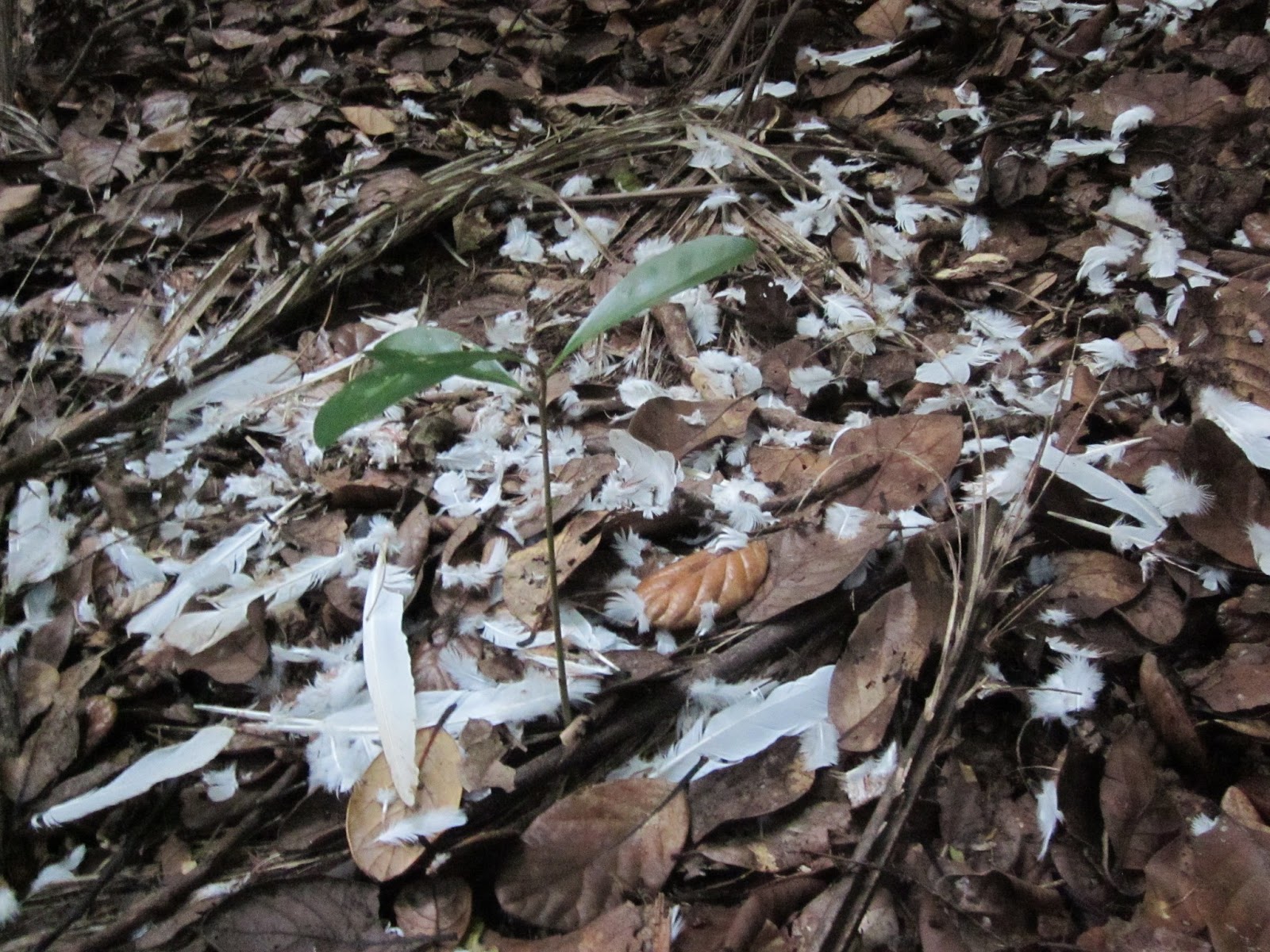
Finally, fearing the worst, I went looking for some sign of what had happened. I searched some of my forest. Nothing. Then I went over into the forest in the adjoining reserve, and to my dismay found many dove feathers scattered near a big tree. Obviously a cat had ended your life. You must have put up a fight, because there were concentrations of feathers in three places. But there was no sign of your remains, so I
cannot even bury you under Dove Rock, the great boulder where I buried the ones that fell ill and died.

People are told to put a bell round cats' necks so that they cannot sneak up on birds, and they are told that they should not even have them if they live near a native reserve. But they ignore that, so fell murder stalks the forest.

Farewell, beautiful bird. I shall miss you for ever. May your murderer meet a swift end, and soon!

BigFeet2 and LightFeet

BigFeet2

Wednesday, 6 February 2013

LIGHTFEET'S LONGEST DAY

LightFeet, the tamest in the flight of wild doves in this forest, has often been in my office for long periods, but never anything like the length of time she spent there today.

She came in at about half past nine in the morning and did not leave till five o'clock in the evening, so she was here for seven and a half hours. She ate and snoozed (mainly in her favourite place on a high shelf), and ate and snoozed, and ate and snoozed, and ate and snoozed.

She has for some time been coming in in the afternoons and eating voraciously, while her mate BigFeet2 has been coming in in the mornings and late evenings, so I think they must have been taking it in turns to feed a chick. Before that they would usually come in together.

The appearance yesterday on the ground of a new chick and the sudden change in LightFeet's behaviour makes me think that she and her mate are the chick's parents, and now that it's on the ground they need not work for it as they have been.

But whatever the reason she had a very relaxing day, as you can see.

In both photos she is sitting on the edge of a high shelf above my desk, looking down at me as I work (the yellow cast on her feathers in the second shot is an artefact of the office light, which the flash did not entirely over-ride).

[Footnote: As the next post reveals, my assumptions about the sudden change in LightFeet's behaviour were, sadly, wrong. I profoundly wish that they had been right.]

Monday, 4 February 2013

LIGHTFEET AND BIGFEET2

If you have read other posts on 'my' doves, you will know that the tamest pair in the flight, and the ones that spend more time in my office than the others are LightFeet and BigFeet2 (so named because compared with his feathery feet and legs hers are lightly feathered, and she was named directly after him, well before they became mates; and he was the second with feet like that).


It is hard to get a closeup of fast-moving doves but I managed earlier to get a fairly good one of them earlier, feeding on muesli on the paper towels that protect the music keyboard--which they make straight for whenever they come inside. I particularly like the way LightFeet's eye has come out. It shows how calm and tame she is, even in the face of a flash going off close to her, and how beautiful her eyes are. As you can see she has grey circlets round them, as does her mate. Many doves have pink ones, but I think the grey is the most beautiful.

LightFeet also has another distinguishing feature--that vertical groove in the feathers on her neck and breast. She has had it since she was a chick. She is also the only one in the flight who purrs. She will settle happily on my shoulder and purr in my ear. She likes being there.

WE HAVE A PROBLEM, MUM

It's not quite 'We have a problem, Houston,' but the latest addition to the flight of doves in my forest, a chick that appeared with the rest at breakfast-time this morning, has just found that fluttering down from the nest for the first time is not as easy as getting back up.

When the rest of the flight went up to their high roosts for the night the chick tried to follow them, but could not get more than a few centimetres off the ground. Its head bobbed about as doves' heads do when they are having a think or are worrying about something, and it was obviously doing both when it contemplated trying to fly just the three metres to the roof on that side of the building, but even that was too much. It had a wander to and fro, fro and to, to and fro, fro and to, to and fro, then tried again, but it was just too daunting. Fluttering is not flying, and fluttering is all it can manage, or summon up the courage for. And strong flying is needed to get to a treetop roost twenty or twenty-five metres off the ground.

It was too quick for me to catch it and take it up a ladder to the roof, so in the end it went under the building, as other new chicks have.

I hope there's no passing cat during the night. But it is better fledged than some other new chicks have been, so if it survives it should not be long before it gets the courage and the strength of wings to be what it is: a wild dove, born in the forest, a creature of air and tall green trees.

(Footnote, next morning: it was alive and well and wailing to every adult to be fed.)

Tuesday, 8 January 2013

DOVE NOTES


I constantly have to remind myself that the doves in my forest are wild birds, because of the extraordinary contrast every day between what they are and the way many of them behave.

Many will fly to my hand to feed contentedly without the slightest sign of fear. And, LightFeet, the friendliest of the flight (the collective noun for doves is a flight), often perches on me, both inside and out. One day she perched on my shoulder for an hour inside with her head tucked into my neck as her mate BigFeet2 is doing to her in the photo below. She even purrs (a sound I have not heard any of the others make).


And as I wrote this paragraph on the last day of 2012, RedFeet was behind me on the cover of my Yamaha keyboard, contentedly pecking at bits of food. A wild bird! She is another very tame one. And clever. She comes and knocks at the door with wings, beak or body when she is hungry, squeezes in as soon as I open it, and when she has had enough goes and stands by the door to be let out, and again squeezes through when the opening is only just wide enough. If I don't notice that she wants to go out she flies to my desk to get my attention.

RedFeet, like all these doves, loves cheese, (as do all the blackbirds in my forest). And she demands it. 'More, more!' she says behind me, and I know she means cheese and that she will not stop saying it over and over again, like an angelic Olivia Twist, until she gets it. And that is exactly what it sounds like: 'More!' in ever more urgent contralto tones, so I fill my hand with little cubes of Colby cheese, stretch it out and she flits
on to it to eat her fill. When BigFeet2 says 'More!' he means kibbled grain first and cheese afterwards, but RedFeet means 'Cheese! Now!'

Most of the names I have given them are to do with their feet, because that is the best way of telling them apart--often the only way--and makes their names easyt to remember. RedFeet has feet that are noticeably redder than the rest. Most of the flight have pink feet, ranging from a rather pale pink up to medium. She also has wider circlets than the rest (the flesh round a bird's eye is called the circlet). In doves it is sometimes grey, sometimes pinkish, sometimes a blend of the two colours. RedFeet's circlets are the widest of the flight, so much so that she always looks wide-eyed. WideEyes could have been her name. LightFeet was given her name after I had named BigFeet2, and was called that because in contrast to him she has lightly-feathered feet and legs.

Her mate is bossy DarkFeet, so named because his feet are a darkish red. He is the biggest bird in the flight, and by far the biggest eater. He could eat the rest under the table. He often comes inside too, frequently with BigFeet2, who is regularly the first to come inside in the mornings. (He was given that name because he was the second dove to be born here who had such well-feathered feet that it made them look big--and beautiful.)

Clever BigFeet2's morning visits have become very regular. I go out, feed the flight, and usually when I come back to my door to find him waiting to come in, because he knows that his favourite food will be on the Yamaha cover (the grain part of toasted muesli). He eats, asks for more, or flits to my desk and gazes hopefully at me with his beautiful eyes, until he has had enough. Then he settles down on the Yamaha cover for an hour or two for a digesting snooze and a grooming session, and/or flies up to a higher place in my office and does the same.

My doveish days begin with the flight either waiting outside my door or descending from the tall trees to be fed as soon as I emerge. To have about twenty doves flying down to you is always a special moment. Mrs Friendly 1 (because she was the first to fly to my hand when the first eight doves came here about three years ago), whose name later became abbreviated to F1, perches on my left hand, the one holding the crusts, so that she will get more than the others as I tear off bits for the flight gathered round me. BigFeet2 perches on my knee so that he will get more too, but far enough from F1 so that she will not be able to squabble with him. When he was younger and had not quite perfected flying to my knee he would fly to my left shoulder and slither down to my knee with wings beating.

Of course many of the adult birds were eating for more than just hemselves earlier in the season. Like other members of the pigeon family they feed their young on 'pigeon-milk,' which looks rather like thin grey porridge. I am sure that one pair had three chicks, because there are three chicks that like to keep together, so that would have kept their parents very busy--and very thin--because young doves are usually quite big and well-fledged before they come down and start to discover how to eat for themselves.

I am intrigued at their different personalities. I took biology at school and zoology at university, but I had always thought of birds as birds. Pretty much all the same. But they are not. They each have their own ways and habits, their own characters. I had had very little to do with animals before the blackbirds and doves came to me because I dislike household pets of any sort. I loathe dogs, and cats only annoy me (especially
when the odd stray tries to get at these doves--and is very soon seen off, at speed). 'Over-rated' and very unnatural is my summary of the entire dog-cat domestic regime. But wild animals, doing what they do out in the natural world, being themselves, but sometimes choosing to become a little tame, is perfect. They stay wild. Even LightFeet is still a wild bird. I am just part of her wilderness. Wild me and wild her.

There used to be a female blackbird that fed from my hand for many years after I managed to tame her sufficiently with Colby cheese, and she brought many clutches of chicks to me over the years, who also became quite tame. I read up on blackbirds and learned that they can live for about twenty-five years, but she must have died because she hasn't been here for well over a year, and although they mate for life her mate has had another mate for about that long. She was my Mrs Friendly in the blackbirds, and she deserved the name because she would often stand a short distance from my hand for a very long time after she had eaten. She obviously liked being there. She would sometimes put one foot on my fingertip when she was feeding.

Now her descendants scoot round the doves, nervously grabbing what they can, because doves are bigger and more numerous and move towards them when they think 'their' food is in danger of vanishing down a blackbird's throat.

Saturday, 22 December 2012

21 DOVES AND 3 NEW CHICKS

It has been a while since I was greeted in the morning by twenty-one doves flying at me and crowding round me. Some of the adults that used to come have gone somewhere else, so the numbers dropped off. They tend to spread out in the breeding season, and some must have now gone too far away to be including my part of the forest in their territories.

But those that remain still include my special favourites, LightFeet (who is on a broad shelf above me as I write this) and her mate BigFeet2 (although his foot-feathers are not as long as they used to be so his feet do not look as big as they did when he was a chick two years ago).

The twenty-one this morning included the second lot of chicks that have come down, three altogether.

One came down much sooner than normal. It either fell or was pushed out of the nest and I found it trying to make its way about on the ground, wailing to be fed. I suspect that it was the smallest in a clutch of three and as its siblings grew there was no longer enough room for it. But for whatever reason it was not nearly as well fledged as chicks normally are when they come down for the first time. They can usually fly. It could not, even walking was not easy, and there was a lot of red skin visible. I picked it up and took it up to where the other doves were; it tried every one of them to get fed, and none did, so none were either parent.


At night it went under the building and found a place to sleep in leaves that had drifted in there. The flash makes it look like day but it was of course black night and it was asleep. To my relief no stray cat or rat got at it, and it must have found a parent, because it grew. One night I saw an adult with it, keeping it company. How sweet!

Then it was joined by what seem to be its siblings. One I call HugeFeet2, because the feathers on its feet stick out so far that it looks as if it has huge feet and there was already a HugeFeet in the first chicks this season. The other I call Flecks because it has flecks of black across the top of its tail.

They move about so fast that it is hard to tell, but it seems that all three are being fed by the same adult, and they like to be together, and nestled together underneath at night, so I think they are siblings.

HugeFeet2
HugeFeet2
HugeFeet2 soon learnt to peck up food from the ground, as you can see, then Flecks worked it out. Even the little one has now. It is funny to see them crying and flapping their wings at the ground at first as if it were a parent and they had to persuade it to feed them in the same way..


But they still cry to their parents and get fed, so they are not yet completely self-sufficient. But why bother pecking at little bits on the ground if you can be stuffed full in nothing flat by a parent? (Doves are members of the pigeon family, which feed their young beak-in-beak on 'pigeon milk': partly-digested food. It looks a bit like thinnish porridge. Chicks put their beaks into their parents' beaks and their parents regurgitate the food straight down their throats.)

Here is Flecks feeding from the ground this morning and later being fed by a parent.


Monday, 29 October 2012

LEARNING WILD DOVES

The wild dove that has been in my office more than any other is the one I call LightFeet (because her feet, or more accurately her legs, are lightly feathered, in contrast to her mate BigFeet2, who has thickly feathered feet and legs, even more thickly than BigFeet1). She is the tamest of the wild doves in my forest, and has been since she was a chick two years ago. She will perch on my arm or shoulder for a long time, even for hours. But she has never, till now, been able to work out how to get out of my office. We have always had to go through long rigmarole, in which she flies up to something higher than the Yamaha keyboard, which might be my head to start with, or something higher up, and looks about all over the place, and finally, if I hold the outer door open long enough and often enough, gets the message and goes out, sometimes on foot, sometimes on the wing.

But RedFeet worked it out very quickly. She goes and stands by the door, the side where it opens, so she knows which is which, and if I do not notice her she flies up to my desk to get my attention, then back down to the door after I get the message and rise to let her out.

She even comes and knocks on the door when she wants to be let in. It took me a while to realise that the thud or peck on the lower corner of the door, again on the side that opens, was her. So now when I hear that I open the door, and she is so eager to get in that she squeezes through when it has only opened just enough.

In recent weeks the two have been coming in together, and LightFeet has watched what RedFeet does and now copies it.

The two cannot be in the same place at the same time, so LightFeet flies up to 'her' territory, the Yamaha, and RedFeet stays on the floor. She knows that if she flies to the Yamaha when LightFeet is there she will be bundled off.

RedFeet's mate, DarkFeet, knows the same thing, but for him the competing bird is LightFeet's mate, BigFeet2, who always flies to the Yamaha. DarkFeet knows not to go there if BigFeet2 is there, although he will sometimes try it on, but when I point to the floor he will go back down. Or BigFeet2 may get to him first and bundle him off with loud protests.

When I go outside in the morning I am greeted by a melee of doves. Fourteen this morning, plus the new chick, which has a fine line of short feathers down each side of its legs, so I call it LineLegs.

After the feeding melee, with doves all about me and on me, a beautiful sea of white bodies and excited wings, some will come inside.

First in is BigFeet2, because he knows he will get more food than if he stays outside with the others. Later in the morning LightFeet and/or RedFeet come in. Or DarkFeet. In the afternoon the same birds will come in. DarkFeet or BigFeet2 are usually the last ones, often not leaving till it is getting dark, which surprises them a bit, because they go out of a well-lit room into the twilight.

All the doves are all cheesaholics (so are the blackbirds). LightFeet, RedFeet and BigFeet2 actually ask for cheese. Literally sometimes. A coo and an expectant look means 'I want cheese, not rolled oats or muesli grain. Cheese! Now!' They know where it comes from. The fridge. So when I go off to the fridge they look expectant and get excited.

I turn my back when I'm cutting it into small cubes, so that they don't fly into what is, first and foremost, my food. But LightFeet often tries to get round that by flying to my shoulder and looking over it.

If she and RedFeet are inside together I have to divide the cheese and hold it out in both hands sufficiently apart to prevent a small battle. LightFeet will fly to one hand, RedFeet to the other.

When there is no more I hold out my hands, empty, they scan them, look disappointed, and wait for more if they have not had enough. Sometimes a bird will gorge itself so much that it will have to massage its crop and stretch upwards about to settle it all down.

Wild doves outside, in my dwelling-place, on my hands. Every day, several times a day. Special times. Dove times.


Monday, 15 October 2012

FRINGES ON A LEDGE

Fringes is learning. As darkness approached I saw that instead of the ground it had chosen a broad ledge on the side of the building on which to spend the night. Safety! :-)

Sunday, 14 October 2012

FRINGES FEEDS


Fringes again spent the night on the ground in its favourite spot--safely, to my relief. In the morning fourteen adult doves came down to feed when I emerged. I assume that the lower numbers means that there are several sitting on nests. And some adults are eating fit to bust but are staying slender, so they must be feeding chicks somewhere.

At first this morning there was the normal melee when they are all scrambling over each other to eat bits of Colby cheese from my hands, followed by bits of bread. Then I scatter rolled oats about. When they were eating the latter Fringes came and joined them and ate too, making the plaintive 'Feed me!' cries to the ground instead of a parent. Earth Mother?

It had tried a little bit of other food on the ground yesterday, rather hesitantly, but today was the first time it had joined the rest and fed with them (I have yet to work out if it is male or female). Quick learner...

I hope it will not be long before it learns that doves go high up into the trees for the night. A parent has been lingering with it until almost dark but it has yet to get the message and follow.

Till it does, stay away cats and dogs!

Thursday, 11 October 2012

FRINGES BENEFITS

'Fringes,' the first of the spring chicks, did survive its all-night stay on the ground, and after making plaintive pleas to adult after adult after adult I saw it find at least one parent, and be fed. :-)

Wednesday, 10 October 2012

FIRST CHICK OF SPRING

I went out at twilight, and found three doves on the ground. Two obviously knew me, but the third, a smaller bird, did not know what to make of this large creature. I soon realised from its ceres, the stains of pigeon milk down its breast, and its plaintive cries that it was the first chick I have seen this spring.

I managed to get a photo of it, although it was just after six so the light was too dim for a good shot, but I did not want to use a flash for fear of frightening it. Adult birds do not mind a flash but it has never seen one.

It obviously did not know what to do, or how to get back to its nest. It must have followed another bird down, but not back, so it had to settle down in a hollow between roots where it will have to spend the night. I'm glad the black cat that had been trying to get at the doves vanished months ago. I hope it survives.

The new bird has distinctive feathering on its legs and feet--rather like the fringes some cowboys had on their leather pants, so I shall call it Fringes.